The Insomnia–Anxiety Connection
If you’ve ever laid in bed exhausted but wide awake, you’re experiencing something researchers have studied closely: a bidirectional relationship between anxiety and sleep. Anxiety disrupts sleep, and poor sleep worsens anxiety — each one feeds the other. Longitudinal research has found that sleep disturbances and anxiety predict one another over time, meaning insomnia can be both a symptom and a cause of anxiety, not just a side effect of it.
Source: Unraveling the complex interplay between insomnia, anxiety, and brain networks — SLEEP (Oxford Academic), 2024
One proposed mechanism is the hyperarousal model of insomnia: a combination of genetic predisposition, stress, and anxious rumination keeps the nervous system in a heightened state of alertness, making it physically harder to fall and stay asleep.
Source: The Role of Rumination and Worry in the Bidirectional Relationship Between Stress and Sleep Quality — PMC, 2025
This is why sleep specialists generally recommend addressing both sides at once — good sleep hygiene alongside stress management — rather than treating either in isolation. If insomnia or anxiety are seriously affecting your daily life, a conversation with a doctor or therapist is the most reliable next step; approaches like Cognitive Behavioral Therapy for Insomnia (CBT-I) have strong research support.
What the Research Says About Each Ingredient
This isn’t a substitute for treatment — but it’s worth knowing what’s actually been studied about the botanicals in Sleep Tight, and being honest about how strong (or limited) that evidence is.
Lavender (Lavandula Angustifolia) — the best-studied of the group
Multiple randomized controlled trials support inhaled lavender for both sleep and anxiety. A 2025 trial in postoperative brain tumor patients found lavender oil inhalation significantly shortened the time it took participants to fall asleep and lowered anxiety scores compared to a control group.
Source: Effects of lavender essential oil inhalation aromatherapy on postoperative sleep quality — Frontiers in Pharmacology, 2025
A separate trial in cancer patients undergoing chemotherapy found lavender oil applied before bed improved sleep quality scores over five nights compared to a saline control.
Source: The efficacy of lavender oil on fatigue and sleep quality in hematological malignancy — PMC, 2025
A multicenter clinical trial protocol is also currently underway specifically studying lavender aroma as a complementary approach for people with diagnosed anxiety disorders, aiming to see whether it can reduce reliance on anti-anxiety medication.
Source: The effect of lavender aroma for anxiety disorder — study protocol, PMC
Geranium (Pelargonium Graveolens) — solid clinical evidence, mostly for anxiety
Several hospital-based randomized trials have tested inhaled geranium oil on anxiety in high-stress medical settings. One triple-blind trial in heart attack patients found geranium aroma significantly reduced anxiety scores compared to placebo. Another trial in women during labor found a similar anxiety-reducing effect.
Source: Effects of geranium aroma on anxiety in AMI patients — ScienceDirect, 2017
Source: Geranium Aromatherapy for Anxiety During Childbirth — Natural Health Research
Valerian Root Extract (Valeriana Officinalis) — long history of use, but mixed clinical evidence
It’s important to be direct here: valerian root is one of the most heavily studied herbal sleep aids, and the research is genuinely inconsistent. Several systematic reviews and meta-analyses of oral valerian supplements have found modest, statistically significant improvements in subjective sleep quality, while other reviews of the same body of research concluded the evidence does not clearly support valerian’s effectiveness for insomnia, citing inconsistent study quality and dosing.
Source: Valerian Root in Treating Sleep Problems and Associated Disorders — systematic review & meta-analysis, SAGE, 2020
Source: Valerian for Sleep — systematic review & meta-analysis, American Journal of Medicine
It’s also worth noting that nearly all of this research studies oral valerian supplements, not topical or aromatic use in a balm — so while valerian root has a long traditional history in calming rituals and contributes a deep, grounding scent, we’re not claiming the clinical sleep research applies directly to how it’s used here.
Vetiver (Vetiveria Zizanoides) — traditional use and early research, mostly preclinical
Vetiver has long been used in traditional aromatherapy for grounding and relaxation. The clinical human evidence is still limited, but a controlled animal study found that inhaled vetiver oil produced anxiety-reducing effects comparable to a standard anti-anxiety medication, along with measurable changes in brain regions involved in anxiety regulation.
Source: Anxiety-like behaviour and c-fos expression in rats that inhaled vetiver essential oil — PubMed
A human clinical trial studying vetiver oil aromatherapy specifically for diagnosed depression and anxiety has been registered and conducted, though as of this writing detailed published results were not yet available in our search.
Source: Study on the Efficacy of Vetiver Essential Oil Aroma on Depression/Anxiety — ClinicalTrials.gov
Sunflower Oil & Beeswax — the base, not the active ingredients
These two make up the bulk of the formula and don’t carry sleep or anxiety research of their own — they’re the carrier oil and thickener that give the balm its texture and let it glide onto skin. Sunflower oil is lightweight and vitamin E-rich; beeswax solidifies the balm and forms a breathable layer that releases scent gradually as it warms from body heat.
The Honest Takeaway
The research is strongest for lavender and geranium as inhaled aromatherapy, mixed for valerian root (and mostly studied orally, not topically), and still early-stage for vetiver in humans. None of this means Sleep Tight cures insomnia or anxiety — it doesn’t, and it isn’t intended to diagnose, treat, cure, or prevent either.
What the research does support is that a consistent, pleasant sensory ritual — the same calming scent, the same few seconds each night — is a reasonable, low-risk part of a broader wind-down routine, alongside the basics: consistent sleep and wake times, screens off before bed, and worries written down rather than replayed.
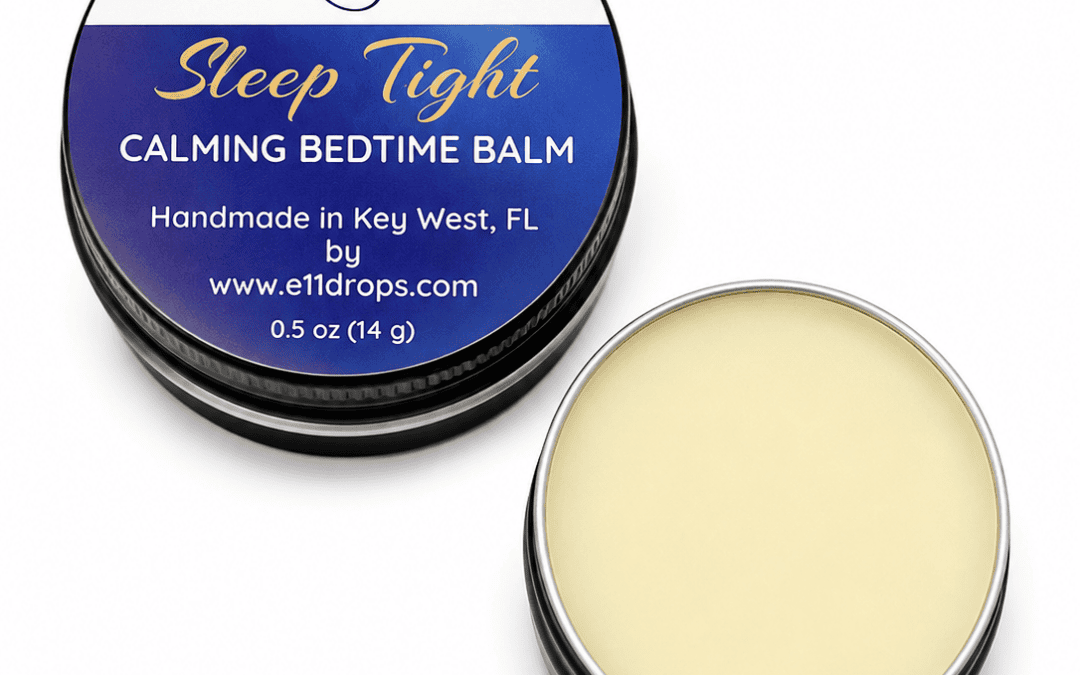
Want to try it as part of your own ritual? Shop Sleep Tight, our calming bedtime balm handmade in Key West, FL.
If sleep or anxiety struggles are persistent or significantly affecting your life, please reach out to a healthcare provider. This post is general information based on published research, not medical advice.